
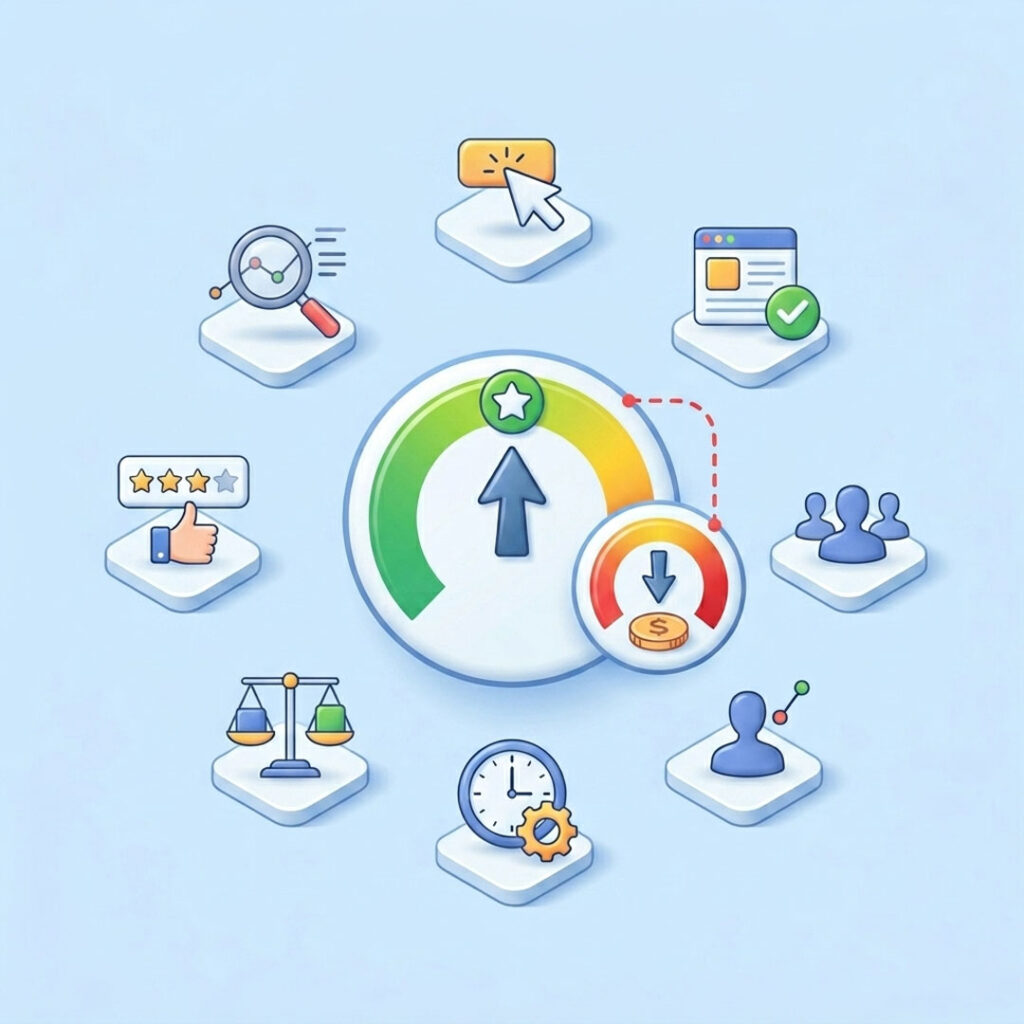
Quality Score is a 1-10 rating Google assigns to each keyword in your account, measuring how relevant your ads and landing pages are to what people search for. 2026 data shows that improving Quality Score from 5 to 8 reduces CPC by 30-40% without changing your bidding strategy at all. This guide teaches you how to check your Quality Score and 7 proven methods to raise it immediately.
What Is Quality Score?
Quality Score is a diagnostic metric that Google assigns to each keyword in your Google Ads account on a 1-to-10 scale (10 being best). It measures how relevant your ads and landing pages are to what people are searching for. Groas explains that in 2026, Quality Score still controls how much you pay per click and whether your ads show at all, even though Google has gradually downplayed it in public messaging.
The simple version: high Quality Score means you pay less and get better ad positions. Low Quality Score means you pay more and your ads may not show at all.
The 3 Components of Quality Score
Google calculates Quality Score from 3 main factors, each carrying different weight.
1. Expected CTR (Click-Through Rate)
Google's prediction of how likely people are to click your ad compared to competitors using the same keyword. Get Ryze confirms that Expected CTR has the highest impact on Quality Score of all three components. If your ads get skipped frequently, your Score drops.
2. Ad Relevance
How closely your ad copy matches the keyword someone searched. If someone searches "affordable web design" but your ad talks about "premium brand strategy," Ad Relevance tanks. Your keyword needs to appear in at least one Headline and the Description.
3. Landing Page Experience
Whether the page visitors land on after clicking delivers what the ad promised. Is it fast? Does it work on mobile? Does it contain useful, relevant information? Adalysis notes that Landing Page Experience is the most overlooked component, yet it has a massive impact on Quality Score.
Why Quality Score Matters (Real Numbers)
Quality Score matters because it determines two things: the actual CPC you pay and your ad position on Google.
Google uses the formula Ad Rank = Bid × Quality Score (plus Ad Extensions). This means an advertiser with Quality Score 8 and a $3 bid beats an advertiser with Quality Score 4 and a $5 bid every time, while paying less.
Get Ryze's 2026 report found that improving Quality Score from 5 to 8 reduces CPC by 30-40% without any bidding changes. Coppett Hill พบว่า across 13 client accounts confirmed that each 1-point Quality Score improvement reduces CPC by 10-20% on non-brand keywords.
Consider this: if your average CPC is $1.20 and Quality Score improves from 5 to 8, CPC drops to roughly $0.72-$0.84. At 1,000 clicks per month, that saves $360-$480 monthly without reducing budget by a single dollar.
How to Check Quality Score in Google Ads
Many advertisers run ads for years without ever checking Quality Score. Here's how to find it.
- Open Google Ads → go to Keywords
- Click the Columns icon Modify columns
- Search for “Quality Score” and add columns for Quality Score, Expected CTR, Ad Relevance, and Landing Page Experience
- Click Apply to see scores for every keyword
Any keyword scoring below 5 needs immediate attention. It's actively draining your budget unnecessarily.
7 Ways to Improve Quality Score
1. Align Ad Copy Directly with Keywords
Your keyword must appear in at least one Headline. If the keyword is "affordable web design," the Headline should contain "affordable web design," not "professional digital solutions." This alone lifts Ad Relevance instantly.
2. Match Landing Pages to Ad Promises
If your ad says "WordPress Website from $299" but the click leads to a homepage with no pricing, Landing Page Experience tanks. Send visitors to a page that delivers exactly what the ad promised.
3. Add Ad Extensions
Sitelinks, Callouts, Structured Snippets, and Call Extensions make your ad larger, taking up more screen space. More space means higher CTR, which improves Expected CTR, which raises Quality Score.
4. Remove Low-Performing Keywords
Keywords with Quality Score 1-3 that have never converted should be deleted. They're draining budget with zero return. Removing them redirects spend toward keywords that actually perform.
5. Tighten Ad Group Structure
Don't cram 30-50 keywords into one Ad Group. Keep 5-15 closely related keywords per group so you can write Ad Copy that matches every keyword in the group precisely.
6. Optimize for Mobile
Over 60% of clicks come from mobile. If your Landing Page is slow, broken, or poorly laid out on mobile, Landing Page Experience drops immediately. Test with PageSpeed Insights and aim for a Mobile Score above 70.
7. Review Search Terms Report Weekly
Get Ryze recommends that accounts adding 20+ Negative Keywords monthly from Search Terms Reports see 8-12% CPC improvements. Blocking irrelevant search terms increases CTR, which boosts Quality Score.
What Quality Score Should You Aim For?
| Quality Score | Level | Action |
|---|---|---|
| 8-10 | Excellent | Maintain. Don't change much. |
| 7 | Good | Minor tweaks. Focus on Extensions + Landing Page. |
| 5-6 | Average | Needs improvement. Check which of the 3 components is lowest. |
| 3-4 | Low | Urgent fix. Rewrite Ad Copy + revamp Landing Page. |
| 1-2 | Critical | Consider deleting the keyword or replacing the Landing Page entirely. |
A realistic target for SMEs is Quality Score 7+ on core keywords. Achieving 8-10 on your most important keywords delivers significant CPC savings.
Bottom Line: Quality Score Is the Best Tool for Cutting Ad Costs
Three things to remember:
- High Quality Score = Lower CPC + Better Position. Improving from 5 to 8 cuts CPC by 30-40%.
- Check all 3 components. Expected CTR, Ad Relevance, Landing Page Experience. Fix the lowest one first.
- Review Search Terms Report weekly. Add at least 20 Negative Keywords per month.
Want to reduce your Google Ads costs without reducing results? The Meawbok8 team audits Quality Score across every keyword, optimizes Ad Copy, and tunes Landing Pages for maximum ROAS. Contact us on LINE @406yntcs for a free Audit.
Frequently Asked Questions About Quality Score
Can You Get a Perfect Quality Score of 10?
Yes, but it's rare. Quality Score 10 usually occurs on Branded Keywords (your own brand name) because Ad Relevance and CTR are naturally very high. For non-branded keywords, a realistic target is 7-8.
How Long Does Quality Score Take to Change?
After adjusting Ad Copy or Landing Pages, Google typically takes 1-2 weeks to update Quality Score, though some cases may take 4-6 weeks. Avoid making changes too frequently. Give the system time to learn.
Does Quality Score Affect Display Ads?
The Quality Score shown in Google Ads applies to Search Network only. Display Network uses a different scoring system that isn't visible to advertisers. However, the same principle applies: ads that match the target audience receive lower CPCs.
What's the Difference Between Quality Score and Ad Rank?
Quality Score is a 1-10 diagnostic metric Google assigns to keywords to measure relevance. Ad Rank is the score used in the actual auction, calculated as Bid multiplied by Quality Score plus Ad Extensions impact. Ad Rank determines your ad position. Quality Score is one input into Ad Rank.
What If Quality Score Is Low But Conversions Are Good?
If a keyword has Quality Score 4-5 but delivers strong Conversion Rate and ROAS, don't delete it. Instead, work on improving Ad Copy and Landing Page alignment to raise the Score. Higher Score means lower CPC, which makes an already profitable keyword even more profitable.