
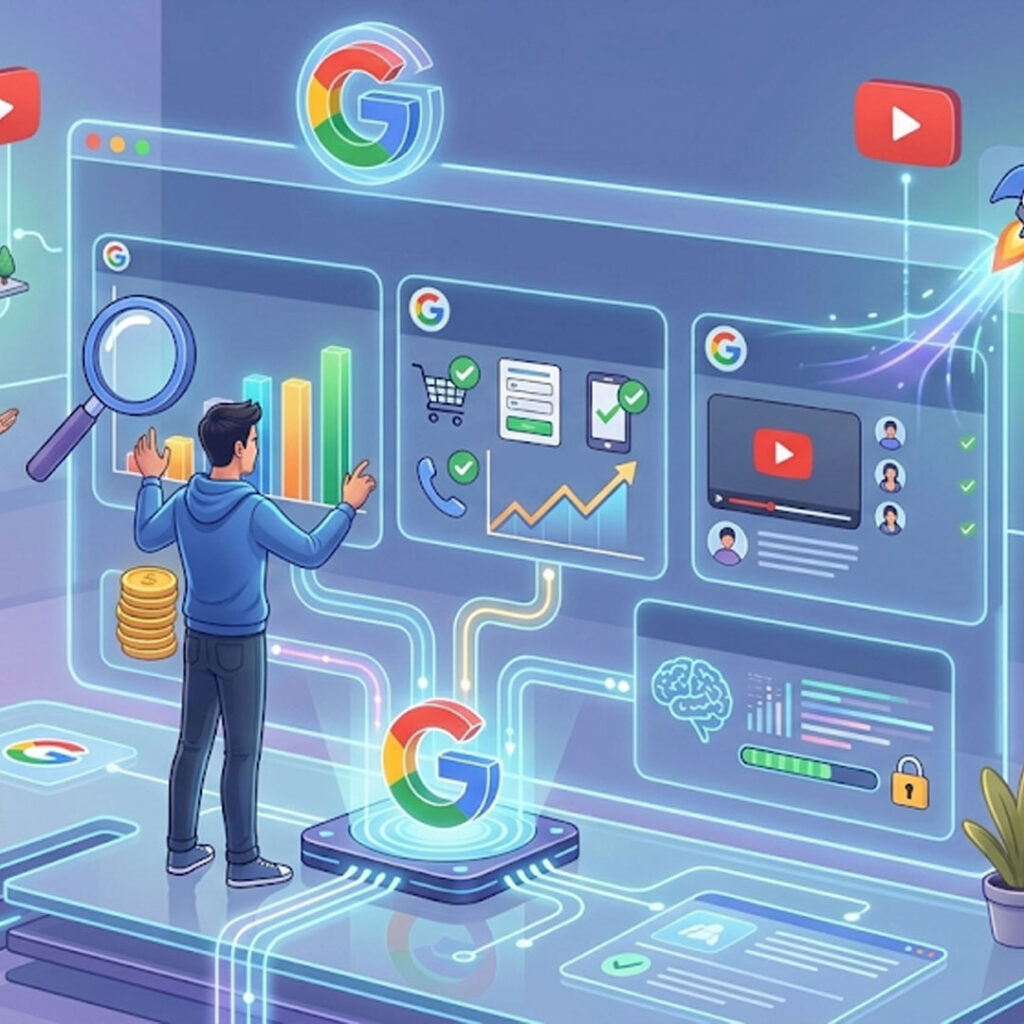
Understand what Google Ads can do in a complete way, from increasing sales, finding new customers, building brand awareness, running keyword-based ads, remarketing, measuring conversions, and choosing the right campaign for the business, so the advertising budget can be used more cost-effectively.
Many people think Google Ads only exists to “make a website appear on Google,” but in reality, it can do much more than that.
Because Google Ads is not just a tool for buying ad space, but a system that helps businesses reach customers at each stage of the decision-making process, from the moment they start searching for information, comparing products, all the way to making contact or placing an actual order.
The key point is that Google Ads can show ads across many Google properties, whether on Search, YouTube, the Display Network, Gmail, Maps, and other channels depending on the campaign type selected. This means businesses do not only have the chance to “be seen,” but also have a better chance to “close the sale” faster.
What is Google Ads?
Google Ads is Google’s online advertising platform that allows advertisers to create campaigns based on business goals such as increasing sales, generating leads, driving more website traffic, increasing phone calls, or building brand awareness. The system then chooses how to show the ads based on the campaign format and available signals, such as keywords, audiences, conversions, and ad quality.
What can Google Ads do, in simple terms? If your business wants people to find you at the exact moment they are searching for a product or service, Google Ads is one of the most effective tools because it can reach “active demand” faster than many other forms of marketing.
What Can Google Ads Do?
Help increase sales faster.
The benefit most people know best is increasing sales, because Search ads can appear directly in front of people who are actively searching for terms related to your products and services, such as “Google Ads management service,” “online advertising agency,” or “Google Ads pricing.”
คนกลุ่มนี้มีแนวโน้มซื้อสูงกว่าการยิงหาคนทั่วไป เพราะเขามีเจตนาค้นหาอยู่แล้ว ถ้าหน้าเว็บไซต์ดี ข้อเสนอชัด และมีระบบติดตามคอนเวอร์ชันครบ โอกาสเปลี่ยนคลิกเป็นลูกค้าจะสูงขึ้นมาก
Generate new customers consistently.
Google Ads is not only suitable for large brands. Small businesses and local businesses can also use it to find new customers.
If the brand is not yet strong, SEO has not ranked yet, or a new service has just been launched, running ads can immediately bring in high-quality traffic, especially for high-intent keywords such as “hire a Google Ads service,” “SEO agency,” or “online marketing consultant.”
Build brand awareness.
If the goal is not only to close sales immediately but also to make more people aware of the brand, Google Ads can do that as well through Display, Video, and Demand Gen campaigns, which help place the brand on YouTube, Gmail, Discover, and across Google’s network of websites.
This format is suitable for businesses that want to build familiarity with customers, or brands that sell products requiring customers to take time and make several considerations before purchasing.
Capture people who are genuinely interested in the product.
Google Ads is especially strong at reaching people with “real intent,” rather than casting ads broadly and hoping to get lucky.
The system supports targeting based on search terms, interests, browsing behavior, demographics, audiences who have previously visited the website, or even existing customer lists through Customer Match. This allows businesses to use the data they already have to drive repeat sales or expand to reach people who are similar to their existing customers.
Remarket to people who have not purchased yet.
Most customers do not make a purchase the first time they see an advertisement.
Google Ads therefore has a remarketing system that allows you to show ads again to people who have previously visited your website, viewed products, added items to their cart, or interacted with your brand before. This helps increase the chance of closing a sale because you are following up with people who “already know you,” rather than starting from zero.
Measure whether the advertising spend is worth it.
One of Google Ads’ biggest strengths is that it can be measured in real terms, not just by looking at how many people saw the ad.
If Conversion Tracking is set up correctly, you can measure exactly what results your ads are generating, such as:
- Fill out a form.
- Phone calls.
- Add on LINE.
- Purchase a product.
- Click an important button.
- Submit contact information.
- Complete an action on the website.
Google clearly states that conversion measurement and conversion tracking help measure actions that are valuable to a business, and that data can also be used to improve campaigns or make Smart Bidding more accurate.
In practical terms, how can Google Ads help a business?
1. Help your website appear on the first page immediately for the keywords you want.
Unlike SEO, which takes time, Google Ads gives businesses the opportunity to appear at the top of search results immediately after the campaign is launched and approved.
2. Help filter in people who are ready to buy first.
If the right keywords are chosen, the business will not waste too much time on traffic that is not relevant to its target audience.
3. Help generate more leads.
Suitable for service businesses such as agencies, clinics, factories, contractors, B2B companies, or businesses where customers need to make contact first before the sale can be closed.
4. Help sell products online.
Especially for stores with a product feed, Shopping or Performance Max can be used to drive more sales.
5. Help encourage existing customers to come back and buy again.
It can be done through remarketing and Customer Match.
6. Help make marketing decisions more accurately.
Because once results can be measured, you will know which keywords close sales, which pages generate revenue, and which audiences deliver the highest quality.
Google Ads campaign types you should know.
Search Campaign
Text ads on Google Search results are ideal for capturing direct demand and are often one of the best campaign types for generating leads or sales across many service-based businesses.
Display Campaign
Banner ads on websites and apps across Google’s network are suitable for building brand awareness, expanding reach, and remarketing.
Video / YouTube Ads
Suitable for brand storytelling, product launches, or building credibility through video, helping people become familiar with the business more quickly.
Demand Gen
Banner ads on websites and apps across Google’s network are suitable for building brand awareness, expanding reach, and remarketing.
Shopping / Performance Max
Suitable for e-commerce businesses, especially when product data and measurement systems are already in place, because products can be shown across multiple Google channels and reach broader inventory through Performance Max.
How precisely can Google Ads target audiences?
One of the most interesting things about Google Ads is that it does not rely only on keywords, but can also use multiple signals together, such as:
- The search terms that users type.
- Interests.
- Search behavior.
- In-market audiences.
- Demographics.
- Target location.
- Target location.
- Existing customer lists.
- People who are similar to existing customers based on signal patterns.
Google Ads Help states that audiences include groups based on interests, intent, and demographics, and that audience targeting can be added across many campaign types, making advertising more precise than broad, unfocused targeting.
Google Ads is not only good at running ads, but also excellent at “optimizing and improving over time.”
A point that many people overlook is that Google Ads is a system that improves the more data it has.
Once the campaign starts generating conversions, the system uses that data to support automated bidding or Smart Bidding, helping find better opportunities to achieve stronger results at a more suitable cost.
Therefore, businesses that track results seriously have an advantage over businesses that simply launch ads and leave them running unattended.
If Enhanced Conversions are added as well, they can further improve measurement accuracy and support more effective bidding.
So, what types of businesses is Google Ads suitable for?
In fact, it can be used for many types of businesses, such as:
- Service businesses that want customers to make direct inquiries.
- B2B businesses that need to generate leads.
- E-commerce businesses that want sales.
- Local businesses that want to reach people in their area.
- Brands that want to build awareness.
- New businesses that have just launched and want immediate traffic.
But what matters more than “can it be done?” is “how to make it worth the investment.”
Because even though Google Ads has strong potential, if the wrong keywords are chosen, the landing page does not meet user intent, or the tracking setup is incomplete, the budget can be drained without bringing in quality customers.
What You Need If You Want Google Ads to Deliver Real Results.
A website or landing page that matches user intent.
No matter how good the ad is, if the website cannot close the sale, the clicks are wasted.
Keywords that match the searcher’s intent.
You need to be able to distinguish which keywords are informational and which ones show purchase intent.
Properly installed Conversion Tracking.
If tracking is incomplete, you will never truly know which campaign is actually worth the investment.
Clear ad copy.
You need to clearly communicate who you are, what makes you good, how you differ from competitors, and what you want the customer to do next.
Continuous campaign optimization.
Google Ads is not something you set up once and finish. You need to keep reading the data and continuously adjust the keywords, audiences, budget, ads, and landing pages.
Common mistakes in running Google Ads.
Many businesses say, “Google Ads doesn’t work,” but in reality, the problem is often not the platform itself, but the way it is being used, such as:
- Using keywords that are too broad.
- Not adding negative keywords.
- Sending traffic to a page that does not match the search query.
- No conversion tracking.
- Measuring only clicks, but not actual customers.
- Not separating campaigns based on objectives.
- Not doing remarketing.
- Writing ad copy that does not clearly explain how the business helps the customer.
Frequently asked questions
Can Google Ads really help increase sales?
Yes, it can—if the business has a clear offer, chooses the right keywords, has a website that matches user intent, and has a complete tracking setup, because Google Ads is designed to measure valuable business actions directly, such as leads or sales.
How is Google Ads different from SEO?
Google Ads is paid advertising that helps you appear in search results quickly, while SEO is the process of optimizing a website to rank organically, which takes more time. Both should be used together, because Ads help generate faster results, while SEO helps build a long-term foundation.
Where can Google Ads appear after you run a campaign?
It can appear in many places depending on the campaign type, such as Google Search, YouTube, Gmail, Discover, the Display Network, Maps, and other placements across Google’s ecosystem.
Is it necessary to install Conversion Tracking?
You should absolutely install it, because without it, you will only know that people clicked, but you will not know who actually became a customer. Google itself also states that conversion measurement is a fundamental part of campaign optimization and automated bidding.
Is Google Ads suitable for small businesses?
Suitable, as long as the budget is managed well, the keywords are chosen precisely, and the campaign starts with a clear objective, such as focusing on leads, phone calls, or sales for the main products first.
Summary
Google Ads does more than just get a website onto the first page, because it is a tool that helps businesses in many dimensions, including increasing sales, finding new customers, building brand awareness, remarketing, measuring results, and using data to keep improving advertising performance over time.
The key is not just “running ads,” but building a campaign structure that matches the objective, choosing the right keywords, tracking conversions completely, and continuously optimizing based on real data.
If done correctly, Google Ads will not be just an expense, but a channel for generating customers and revenue with clearly measurable results.
If needed Plan a Google Ads advertising strategy. To suit your business, from keyword selection, campaign structure planning, ad copywriting, all the way to tracking results to increase sales, you can learn more about the service here. meawbok8.com