
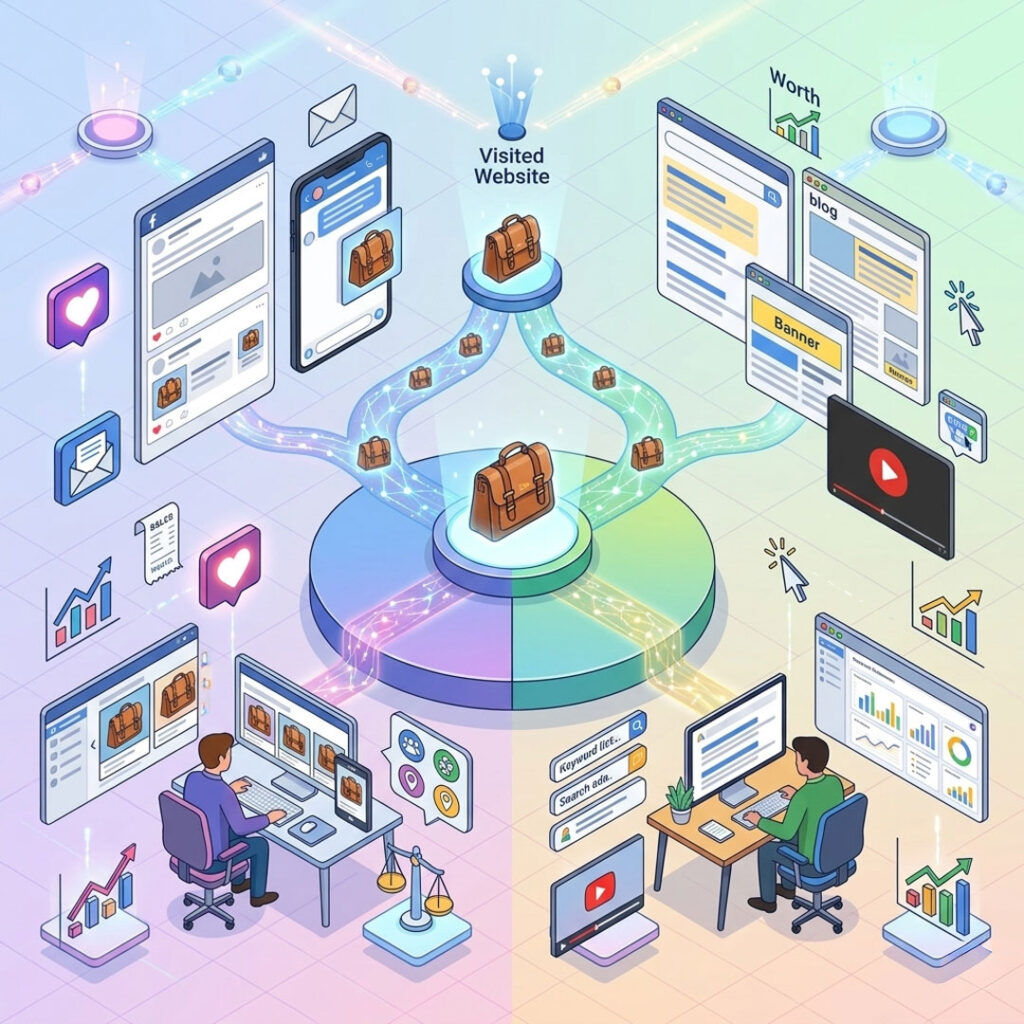
Retargeting means showing ads to people who visited your site but didn't buy, which represents 96% of all website visitors. 2026 data shows retargeted visitors are 70% more likely to buy than first-time visitors, and retargeting ads have 10x higher CTR than regular display ads. Running Facebook and Google retargeting together boosts conversions by up to 60%. This guide teaches SMEs everything they need to know, with 4 actionable examples you can deploy immediately.
Why 96% of Your Website Visitors Don't Buy on Their First Visit
Picture this scenario: you spend $300 on Facebook ads to drive 1,000 visitors to your website. Only 30 of them buy. You celebrate a 3% conversion rate. But here's what you're missing: you just lost 970 people who were interested enough to visit your site but didn't buy.
LeadsBridge reports that 96% of website visitors don't purchase on their first visit. They're comparison shopping, reading reviews, or simply not ready to pay yet. The question is: do you let them disappear forever, or do you bring them back?
This is why the Marketing Rule of 7 still applies in 2026. Customers need to see your brand at least 7 times before deciding to buy. Retargeting is the tool that makes this happen intelligently. It's not about cramming ads in front of strangers. It's about showing ads to people who already know your brand.
What Is Retargeting? Explained in 60 Seconds
Retargeting is an online advertising strategy that shows ads to people who previously visited your website, used your app, or engaged with your brand but didn't convert (buy, sign up, fill out a form). The system uses a Pixel or Tracking Tag to collect visitor data, then serves ads to them on other platforms like Facebook, Instagram, Google Display Network, and YouTube.
You've probably experienced this yourself. Imagine browsing sneakers on Lazada and closing the tab without buying. An hour later, you open Facebook and see ads for those exact sneakers in your feed. That's not coincidence. That's Retargeting Ads following you.
Retargeting vs Remarketing: What's the Difference?
These two terms get used interchangeably all the time, even by major agencies. Criteo lays out the distinction clearly:
| Factor | Retargeting | Remarketing |
|---|---|---|
| Target Audience | Visitors who didn't convert | Existing customers (already converted) |
| Channel | Paid Ads (Facebook, Google Display) | Email, SMS, Direct Outreach |
| Data Source | Pixel/Cookie (Anonymous) | CRM Data (Email, Phone) |
| Goal | Bring people back for first conversion | Repeat purchases, build loyalty |
In practical terms for SMEs, the end goal is identical: bring people back to buy. They just use different channels. So if an agency uses Retargeting and Remarketing interchangeably, don't assume they're clueless. Judge by the results, not the terminology.
How Retargeting Actually Works
The mechanics break down into 3 main steps.
- Install a Pixel or Tag on your website. When someone visits, the system places a Cookie in their browser.
- Visitor leaves without buying but continues browsing other sites. The Cookie is still attached.
- Your ads follow them on Facebook, Instagram, YouTube, or any site in the Google Display Network. This brings them back to convert.
5 Key Benefits of Retargeting Ads SMEs Need to Know
Retargeting Ads outperform regular ads in 5 key dimensions: 10x higher CTR, 70% higher purchase rate, 150% better conversions, half the CPC of search ads, and a 60% conversion boost when combined with traditional ads. This is why 77% of marketers worldwide use retargeting.
1. CTR 10x Higher Than Regular Ads
The Digital Marketing Association reports that retargeting ads have a Click-Through Rate 10x higher than standard display ads. The reason is simple: you're advertising to people who already recognize your brand, not cold strangers.
2. Retargeted Visitors Are 70% More Likely to Buy
Adwisely 2026 data confirms that visitors who see retargeting ads are 70% more likely to purchase compared to first-time visitors. This is why retargeting consistently delivers higher ROAS than cold audience advertising.
3. Conversion Rate Improves by 150%
Advertising to people who already know your brand drives conversion rates 150% higher than advertising to new audiences. They've already cleared the "brand awareness" hurdle and just need a final push to commit.
4. CPC Is Half the Cost of Search Ads
Cost Per Click on retargeting ads runs about half of standard Search Ads CPC because competition in the Display Network is lower than the Search Network. Your ad budget gets you more clicks at the same spend.
5. Combined Retargeting Boosts Conversions by 60%
SQ Magazine 2026 reports that combining Facebook and Google retargeting drives a 60% increase in conversions versus using only one platform. Customers use both platforms, so appearing on both means massive brand recall throughout the day.
Facebook Retargeting vs Google Retargeting: What's the Difference?
This is the question SMEs ask me most. Let me lay it out clearly.
| Factor | Facebook Retargeting | Google Retargeting |
|---|---|---|
| Tools | Meta Pixel + Conversions API | Google Ads Tag |
| Ad Placement | Facebook, Instagram, Messenger, Audience Network | 2M+ sites on Display Network, YouTube, Gmail |
| Strengths | Visual, Engagement-based, Creative | Search Intent, RLSA, Cross-device |
| Ad types | Carousel, Video, Stories, Dynamic Product Ads | Responsive Display, Banner, Text, Video |
| Minimum Audience | 100 people | 100 (Display) / 1,000 (Search RLSA) |
| Best For | E-commerce, Brand Building, B2C | High-intent, Lead Generation, B2B |
When to Use Facebook Retargeting
Facebook excels at Visual + Emotional Connection because customers scroll the feed with "emotion" rather than "search intent." It's ideal for:
- E-commerce businesses with strong product photography, ready to deploy as Carousels or Dynamic Product Ads
- Brand awareness campaigns, especially for newer brands wanting to be remembered
- B2C customers who decide with emotion: cosmetics, fashion, food
Meawbok8 offers Facebook Ads สำหรับ SME with retargeting included in the main package, no upcharge.
When to Use Google Retargeting
Google excels at Search Intent + Cross-device because it follows users across every device they're logged into a Google Account on. It's ideal for:
- B2B businesses or services where customers research before deciding
- Long sales cycle businesses like real estate, finance, and education
- Brands wanting to use RLSA (Remarketing List for Search Ads), the secret weapon that catches customers exactly when they're searching for an answer
Check out Meawbok8's Google Ads Remarketing service, which covers everything from Tag installation to audience building and ad management.
Why Most SMEs Should Use Both Platforms Together
The short answer is +60% Conversion per the research above. The longer answer: a single customer uses both Facebook and Google on the same day. They might search on Google in the morning and scroll Facebook in the evening. Showing up on both keeps your brand front-of-mind all day.
One word of caution: don't over-serve. Set a Frequency Cap at 3-5 impressions per week. Beyond that, customers get annoyed and block your brand.
4 Retargeting Examples SMEs Can Deploy Right Now
Enough theory. Here are 4 real-world examples you can start using today.
Example 1: Cart Abandoners — People Who Added Items But Didn't Check Out
This is the most "purchase-ready" segment in your system. They likely stalled on shipping costs, waiting for payday, or had a temporary change of heart.
Strategy: Serve Dynamic Ads showing the exact products in their cart, paired with a 10% Discount Code or Free Shipping offer, within 24-48 hours.
Recommended Window: 1-7 days (short, because memory fades fast)
Example 2: Page Viewers — People Who Viewed Products But Didn't Buy
This group is interested but undecided. They might be hesitating, researching more, or comparing prices elsewhere.
Strategy: Carousel Ads showing similar products plus Social Proof (real customer reviews) and Testimonial Videos.
Recommended Window: 14-30 days
Example 3: Video Viewers — People Who Watched 50%+ of Your Facebook Video
Anyone who watches more than half of a video is signaling high interest. This is a "warm" group ready for conversion-focused ads.
Strategy: Serve deeper Lead Generation ads like "Download our free guide" or "Book a free 30-minute consultation."
Recommended Window: 30-60 days
Example 4: Past Customers — Buyers from 3-6 Months Ago
Past customers are the Gold Mine most SMEs forget. Selling to existing customers is 5-25x cheaper than acquiring new ones.
Strategy: Cross-sell (related products) or Upsell (premium versions) plus Reactivation campaigns with special offers.
Recommended Window: 90-180 days post-purchase
6 Common Retargeting Mistakes SMEs Make
After 10 years working with Thai SMEs, I see the same mistakes repeatedly. Avoid these 6 and your ROAS jumps immediately.
1. Targeting Everyone Without Segmenting. Someone who only viewed your homepage has completely different intent than someone who added items to their cart. Showing them the same ad wastes budget. You need separate audiences and separate messaging.
2. Running the Same Creative for a Month. Ad Fatigue kicks in fast with retargeting because customers see the same ad repeatedly. Refresh creative every 2 weeks, with at least 3-5 rotating variations.
3. Forgetting to Exclude Converters. The most expensive mistake: forgetting to remove people who already converted from your audience. The result is serving ads to people who already bought, pure budget waste.
4. Not Setting a Frequency Cap. If a customer sees the same ad 20 times in a week, they get annoyed and block you. Cap impressions at 3-5 per week, which is the safe industry standard.
5. Audience Windows That Are Too Wide. Setting a 180-day window for products with fast decision cycles means advertising to people who've already forgotten your brand. Match your Window to your sales cycle.
6. Relying on Old Pixels with Dying Cookies. In 2026, traditional cookies have limited reach due to iOS Privacy rules and browser restrictions. You need to upgrade to Conversions API (Server-side Tracking) or Enhanced Conversions ของ Google
How to Start Retargeting with Zero Experience
Starting retargeting breaks into 3 main steps: installing the Pixel/Tag on your website, building Custom Audiences from visitor behavior, and launching ads with measurement. Initial setup takes about 2-4 weeks.
1. Install Meta Pixel + Google Tag
This is where everything starts. Install the Pixel/Tag on every page of your site, then configure Conversion Events like ViewContent, AddToCart, and Purchase. In 2026, also install Meta's Conversions API, not just the standard Pixel.
2. Build Custom Audiences from Behavior
After 7-14 days of Pixel data collection, you'll have enough data to start. Build audiences using the 4 examples above. Always exclude people who already converted.
3. Design Ads, Launch, and Measure
Create ad creative that speaks directly to each audience. Start with a budget of $30-100 per day. Launch and track key metrics: ROAS, CPA, and Conversion Rate. Adjust weekly.
If these 3 steps sound overwhelming or you don't have time to manage them yourself, hiring an experienced agencyis usually the better trade-off. Trial and error in Ads Manager costs real money, not just time.
Bottom Line: Is Retargeting Worth It for SMEs?
The short answer is absolutely, for any SME with at least 500-1,000 monthly website visitors. Retargeting is the only ad type that consistently delivers higher ROAS than regular advertising, regardless of business size.
Three things to remember:
- 96% of website visitors don't buy on the first visit. Retargeting is the only way to bring them back.
- Run Facebook + Google together. Combined retargeting drives 60% more conversions because customers use both platforms.
- Segment your audiences and rotate creative regularly. Avoid Ad Fatigue and wasted budget.
At Meawbok8, we've been running retargeting for Thai SMEs for 10 years. We cover both Google Remarketing and Facebook Retargeting under one roof, which captures the full +60% Combined Conversion boost the research shows. Average ROAS for e-commerce clients runs 5-15x.
Want to bring your visitors back to buy? Contact us on LINE @406yntcs for a free Audit to check if your site is retargeting-ready, plus a quote within 24 hours.
Frequently Asked Questions About Retargeting
What's the Difference Between Retargeting and Remarketing?
Retargeting คือการยิงโฆษณา Paid Ads (Facebook, Google) ตามคนที่ยังไม่ Convert ใช้ข้อมูล Cookie/Pixel ส่วน Remarketing คือการส่ง Email หรือ SMS ไปหาลูกค้าที่ Convert แล้ว ใช้ข้อมูล CRM ผลลัพธ์เหมือนกันคือดึงคนกลับมา แต่ใช้คนละช่องทาง
How Much Do Retargeting Ads Cost?
Retargeting means running Paid Ads (Facebook, Google) to people who haven't converted yet, using Cookie/Pixel data. Remarketing means sending Email or SMS to customers who already converted, using CRM data. The end goal is identical (bring people back), but the channels are different.
How Many Visitors Do I Need to Start Retargeting?
Facebook Retargeting requires a minimum audience of 100 people within the last 30 days. Google Retargeting needs 100 people for Display Network and 1,000 for Search Remarketing (RLSA). If your site is new and lacks traffic, invest in SEO or Search Ads first to build a visitor base.
Won't Retargeting Annoy My Customers?
If you set it up badly, absolutely yes. Set a Frequency Cap at 3-5 impressions per week, rotate creative every 2 weeks, and exclude people who already converted. Done right, retargeting feels like a "friendly reminder" rather than spam.
Can I Do Retargeting Myself?
Yes, but expect 2-3 months learning Meta Ads Manager and Google Ads Manager, plus understanding Pixel installation, Conversions API setup, and proper audience building. For SMEs short on time, hiring a specialized agency usually wins, because trial and error in Ads Manager costs real money, not just time.