
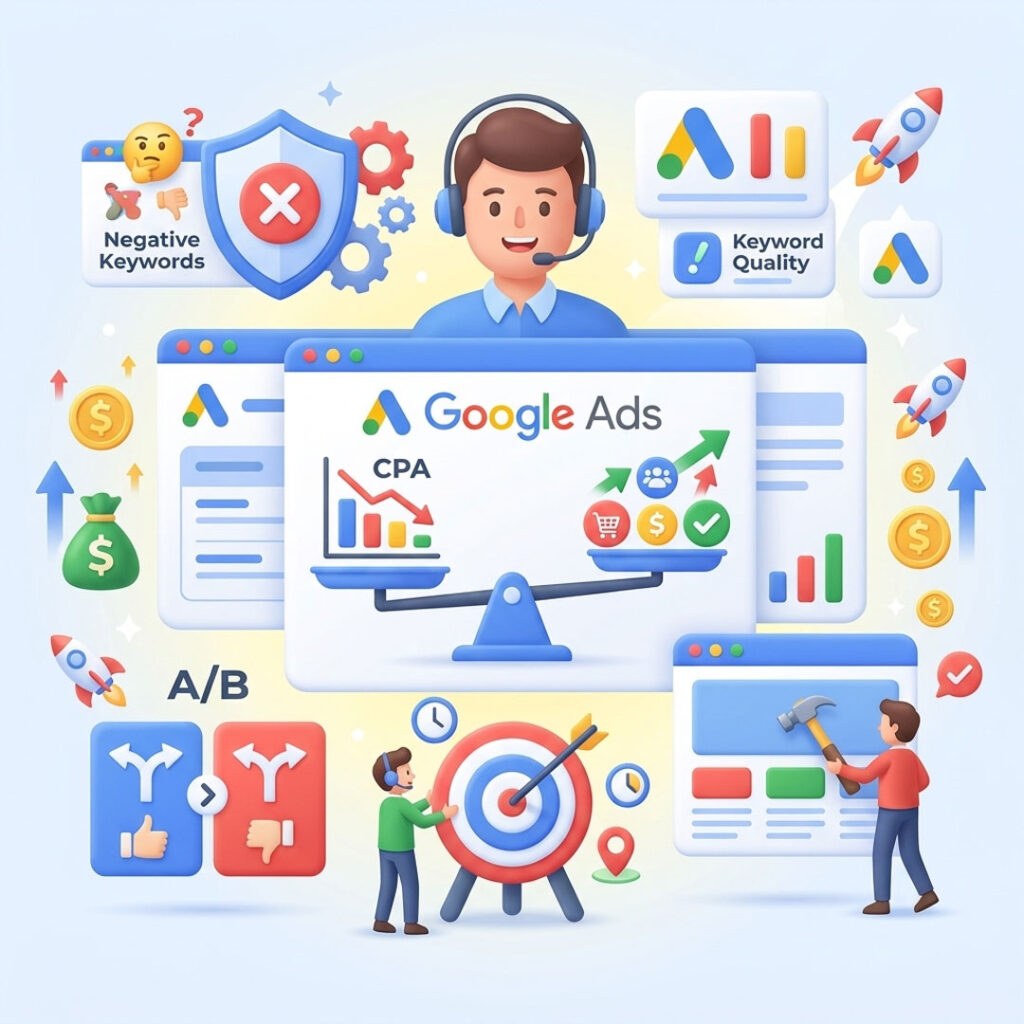
CPA (Cost Per Acquisition) is how much you spend in ads to get one customer. In 2026, the average Google Ads Search CPA is $76.12. Improving Quality Score from 5 to 8 cuts CPA by 25-40%, and optimizing a Landing Page to lift Conversion Rate from 2% to 3% delivers the same CPA reduction as cutting CPC by 33%. This guide covers 7 techniques that reduce CPA immediately without increasing budget.
What Is CPA and Why Lower Is Always Better
CPA stands for Cost Per Acquisition. It's the amount you spend on advertising to get one customer. The formula is simple: CPA = Total Ad Spend ÷ Number of Conversions.
Example: Spend $900, get 10 customers → CPA = $90 per customer.
CPA differs from CPC in a critical way. CPC is the cost per click, but CPA is the cost per actual customer. Someone might click 100 times but only buy 3 times. CPC could be cheap while CPA is expensive. Dizispark explains that CPA is the metric that answers the most important question in advertising: "Is this campaign profitable or losing money?"
Lower CPA is always better because it means you pay less per customer, profit per customer increases, and you can scale without costs spiraling out of control.
What's a Good CPA? Benchmarks by Industry
The answer depends on your industry Synter compiled 2025-2026 CPA benchmarks across industries:
| Industry | Average CPA (Search) |
|---|---|
| Automotive | $33.52 |
| E-Commerce | $45.27 |
| Education | $72.70 |
| Legal | $86.02 |
| Technology | $133.52 |
| Cross-Industry Average | $76.12 |
A simple rule that works for any business: CPA should not exceed 20-30% of revenue per customer. If your product sells for $300, CPA shouldn't exceed $60-$90. Above that, the campaign is losing money.
7 Techniques to Reduce CPA Immediately
1. Improve Quality Score
Altois' 2026 research found that improving Quality Score from 5 to 8 reduces CPC by 25-40%, which cuts CPA by the same proportion. The approach: align Ad Copy with Keywords, match Landing Pages to ad promises, and add Ad Extensions.
This is the highest-impact technique of all 7 because it reduces CPA without cutting budget or changing your Bidding Strategy.
2. Optimize Landing Pages Before Adjusting Bids
Specflux demonstrates that lifting Conversion Rate from 2% to 3% (a 50% relative improvement) delivers the same CPA reduction as cutting CPC by 33%. But cutting CPC means winning increasingly expensive auctions, while improving a Landing Page is entirely within your control.
Key areas to optimize: load time under 3 seconds, clear CTA visible without scrolling, content matching the ad, mobile-friendly design, and minimizing form fields.
3. Add Negative Keywords Every Week
Check your Search Terms Report weekly and block irrelevant queries. G2C Partners recommends that consistent Negative Keyword additions reduce CPA by 10-20% because budget stops burning on clicks that will never become customers.
Example: If you sell "WordPress web design" but see the search term "free WordPress tutorial," block "free" and "tutorial" immediately.
4. Use Smart Bidding Correctly
Groas explains that Smart Bidding in 2026 reduces CPA by 10-30% after the learning period, but only when used properly.
- Target CPA: Use when you have at least 30 conversions in the past 30 days. Set the target at your current CPA, then gradually lower it by 10-15% at a time.
- Maximize Conversions: Use for new campaigns with limited conversion data. Let the system learn for 2-4 weeks before switching to Target CPA.
- Daily Budget must be at least 2x your Target CPA. If Target CPA is $50, budget should be at least $100/day.
Store Growers warns against optimizing for micro-conversions like page views or add-to-cart events. These inflate reported conversion counts while masking true CPA. Optimize only for macro-conversions like purchases or lead form submissions.
5. Use Remarketing to Cut CPA by 50%+
Remarketing Ads consistently deliver lower CPA than acquisition campaigns because they target people who already know your brand. Conversion Rates run 150% higher, so CPA drops automatically.
Separate your Remarketing budget from Acquisition budget clearly. Allocate 20-30% of total spend to Remarketing with the remaining 70-80% for new customer acquisition.
6. Adjust Bids by Device and Time
Dizispark recommends checking whether Mobile CPA differs from Desktop CPA. If Mobile CPA is 60% higher than Desktop, apply a -30% bid adjustment on Mobile and redirect that spend to Desktop.
Apply the same logic to time of day. If CPA between 10 PM and 6 AM is significantly higher than during business hours, reduce bids by 20-40% during those windows. Find these numbers in the Devices and Ad Schedule reports in Google Ads.
7. A/B Test Ad Copy Consistently
Run at least 3 Ad Copy variations per Ad Group simultaneously. Let them run 2-4 weeks, then pause the lowest CTR and Conversion Rate performer. Write a replacement. Repeat monthly.
Key elements to test: Headlines (changing 2-3 words can shift results), Descriptions (different CTAs), and Display URL Paths (different keyword variations).
Mistakes That Cause CPA to Spike
Avoid these 5 and CPA stays under control.
1. Running Broad Match Without Negative Keywords. Broad Match pulls high traffic volume but too wide. Without Negative Keywords filtering irrelevant queries, budget burns on clicks that never convert.
2. Landing Pages That Load Over 3 Seconds. Specflux reports that pages loading in 6 seconds see 70-80% bounce rates. That means 7-8 out of every 10 paid clicks are wasted money.
3. Not Separating Campaigns by Intent. Mixing keywords with different intent (like "what is Google Ads" and "hire Google Ads agency") in one campaign prevents proper bid optimization by intent. CPA rises unnecessarily.
4. Not Excluding Existing Customers. Serving ads to people who already converted means paying for the same customer twice. Build an audience of past converters and exclude them from acquisition campaigns.
5. Changing Bidding Strategy Too Frequently. Smart Bidding needs 2-4 weeks to learn. Switching every week prevents the system from stabilizing. CPA stays volatile.
Bottom Line: Lower CPA = More Profit Without More Budget
Three things to remember:
- Fix Quality Score + Landing Page before touching Bids. Cuts CPA 25-40% without reducing budget.
- Add Negative Keywords weekly. Saves another 10-20% by stopping budget waste on irrelevant clicks.
- Use Remarketing with a separate budget. Always delivers lower CPA because you're targeting people who already know your brand.
If you've tried all 7 techniques and CPA is still high, the problem may run deeper than surface optimization. At Meawbok8, we audit entire Google Ads accounts for Thai SMEs, find the "leaks" where budget is draining, and plug them within 30 days. With 10 years of experience and peak ROAS of 39x.
Contact us on LINE @406yntcs for a free Audit plus a quote within 24 hours.
Frequently Asked Questions About CPA
What's the Difference Between CPA and CPC?
CPC is the cost per click. CPA is the cost per actual customer. Someone might click 100 times (100 CPCs) but only buy 3 times (3 CPAs). CPA matters more than CPC because it tells you whether the campaign is actually profitable. Low CPC but high CPA means the campaign is losing money.
What Percentage of Product Price Should CPA Be?
The general rule is CPA should not exceed 20-30% of revenue per customer. If your product sells for $150, CPA should stay below $30-$45. Businesses with high Customer Lifetime Value (SaaS, subscriptions) can accept higher CPA because customers pay repeatedly over many months.
Can You Reduce CPA Without Reducing Conversions?
Yes. The best methods are improving Quality Score and optimizing Landing Pages. Both reduce CPA without affecting conversion volume at all. This is different from cutting bids, which can reduce ad visibility and lower conversions along with CPA.
Is Smart Bidding Really Better Than Manual?
In 2026, Smart Bidding outperforms Manual for accounts with at least 30 conversions per month. Google's AI processes over 100 signals per auction that humans can't match. However, if you have fewer than 15 conversions monthly, Manual CPC is still better because the AI doesn't have enough data to learn effectively.
What Should I Do If CPA Keeps Rising?
Continuously rising CPA usually stems from 3 causes: CPC inflation from increasing competition (typically 10-15% annually), falling Conversion Rate from outdated Landing Pages or stronger competitors, or Audience Fatigue from showing the same ads too long. Check all three and fix whichever is the biggest contributor first.