
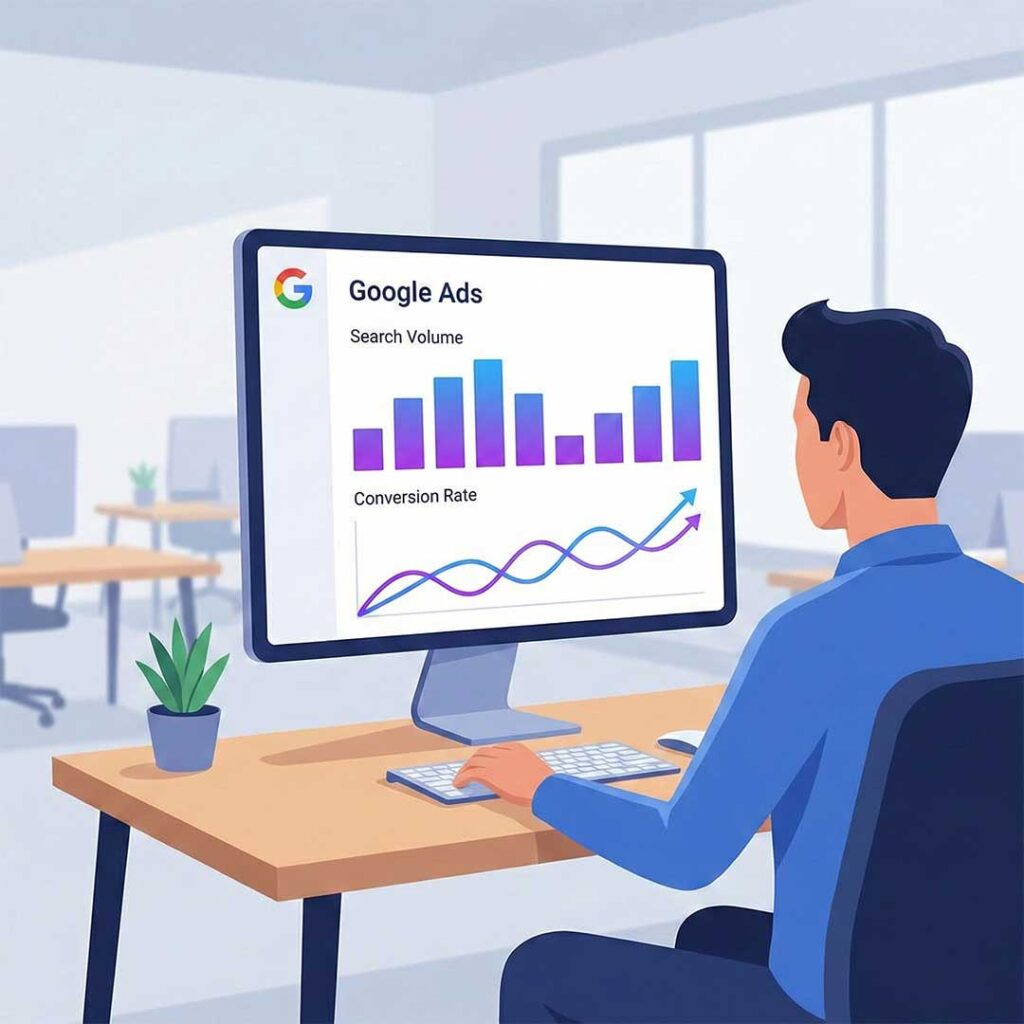
Many businesses that are just beginning to adapt to online commerce have probably heard of Google Ads, Google’s advertising tool that helps place business ads in front of users simply by paying, setting a budget, and defining the product’s target audience.
But the more important truth is that Google Ads is the world’s most precise tool for capturing demand. That is why each ad campaign must define the product’s target audience clearly, because Google Ads has strong potential to display an ad at the exact moment a person wants to buy that product or service—if the campaign is set up correctly.
Therefore, understanding the true structure and strategy of Google Ads is not just about running ads for visibility, but about building a system that allows your business to appear in front of customers at the exact moment they are ready to buy.
Understanding Google Ads: What is it and how does it work?
Google Ads is the world’s largest Pay-Per-Click (PPC) advertising system. The main principle is that you only pay when someone actually “clicks” on your ad. Google uses an auction system together with Quality Score to determine whose ad will appear in the top positions. Ads are divided into the following categories:
1) Search Network
These are ads that appear on the Google Search results page when someone types in the keywords you have selected. The ads are shown in text format, and this is considered the channel with the highest conversion rate because it directly matches the user’s intent at that moment.
2) Display Network
It involves placing banner ads across Google’s partner websites or various applications, with a focus on building awareness and running remarketing campaigns to bring previous customers back for repeat purchases.
3) Video Ads (YouTube Ads)
In 2026, YouTube remains the number one video platform. Advertising here helps strengthen brand image and allows businesses to reach highly specific target audiences based on their interests.
How is Google Ads different from advertising on social media?
To make the difference clearer, we need to separate marketing into two sides, and Google Ads has a unique strength that no one can truly replicate:
- Inbound Marketing (pull marketing): The customer is the one who initiates the search because they already have a need, such as “urgent air conditioner repair” or “condo near the BTS,” unlike social media, which is a form of marketing based on Interruption Marketing interruption marketing, where ads appear while people are consuming entertainment.
- High Intent (strong purchase intent): People who search on Google have a higher chance of becoming customers because they have already moved through part of the decision-making process.
- Precision Timing (the right timing): Google’s AI system in 2026 can analyze whether a user is currently in the “price comparison” stage or the “ready to pay” stage, making every advertising dollar spent more worthwhile.
3 Key Factors That Make Your Google Ads Truly Sell in 2026
Setting up the ads accounts for only 20% of success, while the other 80% comes from having a consistent strategy—especially in a year when AI plays a major role. You need to focus on these three areas:
1) Focus on Search Intent more than just Keywords.
In the past, we may have focused on using short keywords, but today we need to look deeper into what the customer truly wants.
- Information Intent: For example, “how to take care of running shoes” (this group is looking for information and is not ready to buy yet).
- Transactional Intent: For example, “buy Nike running shoes model… on sale” (this group is the core target that should be directly targeted with ads). Using long-tail keywords may attract fewer searches, but these users are more likely to make an actual purchase, and the cost per click is often lower as well.
2) Ad copy must “solve a problem” and “drive decision-making.”
The ad headline is the most important part. Do not write only the name of the store; write the “benefit” that the customer will receive.
- Bad example: “Water Pump Repair Shop in Bang Na”
- A sales-driven example: “If your water pump is broken, call us 24/7. We arrive at your home within 30 minutes, with professional technicians and a 1-year repair warranty.” Including a clear Call to Action, such as “Get 50% off today only,” can significantly increase click-through rates.
3) The landing page must be designed to “close the sale.”
The ad’s job is to “bring people into the house,” but the landing page is what “closes the deal.” If the webpage is not ready, sales will not happen.
- Speed & Mobile First: The website must load within 2–3 seconds and display beautifully on mobile devices.
- Trust Signals: Customer reviews, certifications, or trust and security badges.
- Easy Conversion: The Line contact button, order button, or contact form must stand out clearly so customers do not have to look for them themselves.
What are the risks to your business if Google Ads are not done correctly?
- Wasting money on “junk clicks”: If your keywords are too broad, people may click out of curiosity without making a purchase, causing your budget to disappear very quickly.
- Losing opportunities to competitors: While you hesitate, competitors who run Google Ads systematically will capture the customers who already have real purchase intent.
- Advertising costs keep getting more expensive. If you do not improve your Quality Score, Google will always charge you a higher cost per click than your competitors.
Conclusion
In summary, Google Ads is the most powerful tool for capturing the demand of customers who are already searching for your products or services. Making ads generate real sales does not depend solely on having a large budget or pushing ads to reach a high number of impressions.
It depends on understanding your own customers’ behavior, choosing words that reflect purchase intent, and preparing your website to be ready for sales. Finally, if you want to start running ads but do not know how to begin, or you need a consultant to help plan your Google Ads so every baht is spent cost-effectively, our team at MEAWBOK is ready to support and advise you. You can contact us through the following channels.